Tuesday, October 27, 2009

2009 Stone Tower 15K race report


Following up on yesterday's disappointing attempt to defend my title, I thought I had enough legs for one more hard effort before shutting it down for the month of November. I texted my buddy Anuj Saturday night to see if he was interested, and he was game despite having never done a trail race. Sometimes these races done on a whim turn out to be more enjoyable than the ones you plan for!


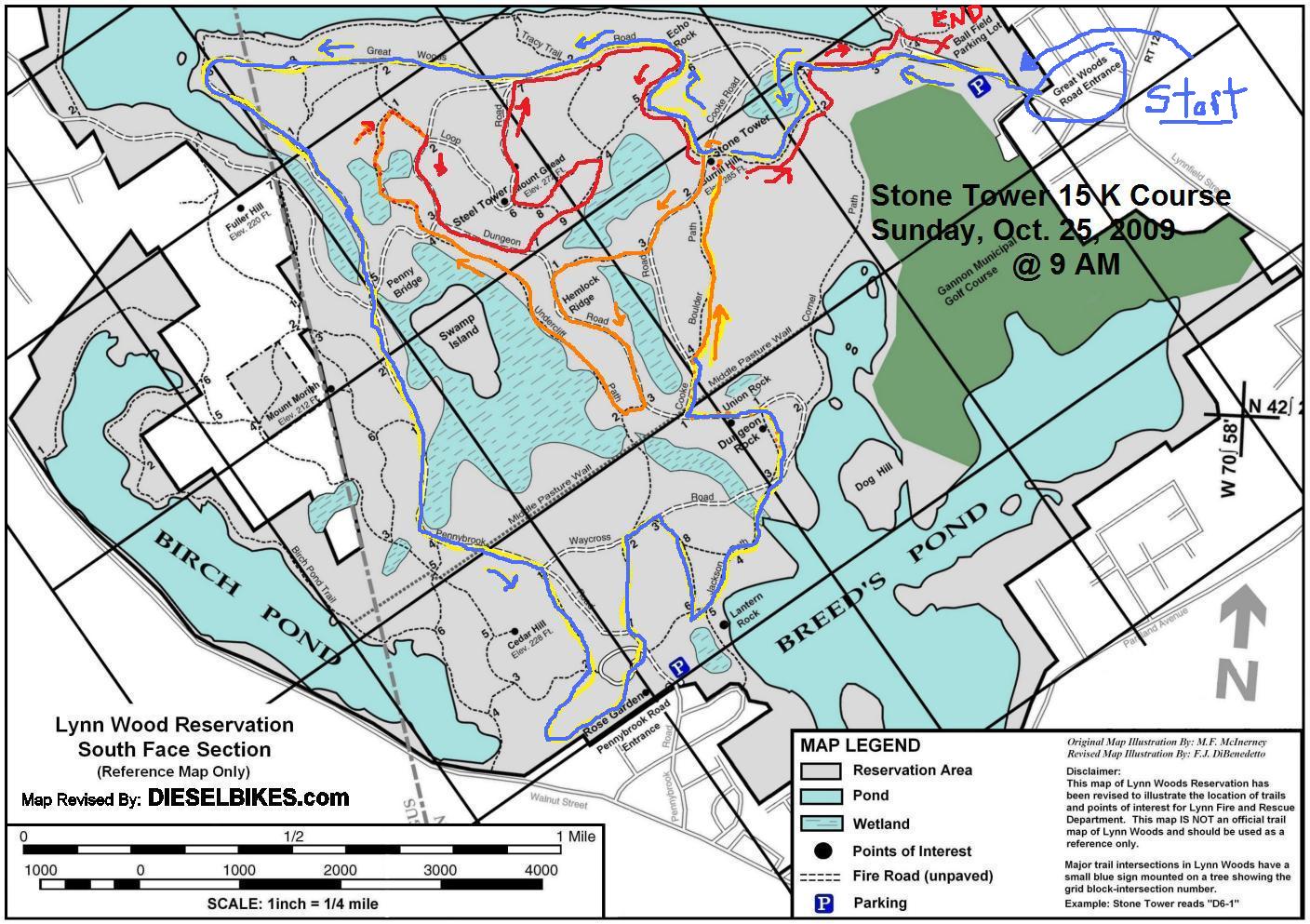
This is the 2nd edition of Stone Tower 15K, and the course is challenging without being overly technical. This course is a next door neighbor to the infinitely more famous Great Stew Chase 15K, but it's a totally different animal. It's run in the Lynn Woods Reservation, mostly on carriage roads, but with enough single track to spice things up and test your climbing legs. It's not a technical monster like the Skyline Trail 7.2, but it's no cross country race either. I ente
red this trail race last year, the week prior to the NYC marathon, to add some spice to my last long run without killing my legs. I ran a 1:10:56, and finished in 6th place. This year, however, I was mostly recovered from the BAA Half and dedicated to really hammering the second half of this race to see how much I could beat my time from last year. Besides, I was still pissed about my effort level yesterday, and wanted to redeem myself.

Anuj and I arrived with about 15 minutes to spare. We had enough time to register and do a short warm-up before the start. The race started pretty conservatively, and I spotted the usual suspects (Paul Young and Chris Smith, 1st and 3rd, respectively, from last year's race) leading the charge. These two mountain goats are clearly a class above me, so I settled in at 4th or 5th place as we hit transitioned from asphalt to the trail. The first section is fairly rocky, but the footing was solid despite yesterday's soaking rain. I eased into the
first climb towards Stone Tower and slowly made up ground on 3rd place before hitting the first long descent. I was passed by a different runner with long hair halfway down the first descent, and I could tell by the way he was moving that I wasn't keeping up with him for now.


As far as tactics go in trail racing, although I'm not a veteran, I have done enough races to know that my strength lies in descending and my weakness is the techinical stuff. I would think that with all the basketball I play, the lateral movement wouldn't be a problem. However, the muscles utlized are clearly different. Basically, I stay strong on the climbs, try not to lose to much on the techinical descents, and really hammer the long downhills. The first third of the race is on wide carriage trails, so it was easy to settle into a nice rhythm. My body was beginning to warm-up and I was feeling much stronger than yesterday. As we hit the Rose Garden and the first aid station, I could hear another runner behind me within striking distance and it helped me to stay focused. I was comfortably in 4th by the time we hit Stone Tower the second time, but with the more technical 2nd half ahead, I knew I had work to do.

The next segment until the third pass of Stone Tower was the deciding segment of the race for me. There was no one to key off of in front, but I was shadowed from behind by a runner who would gain on the technical sections, but fade on the long climbs. I never thought of myself as a good climber, but these techinical portions were really highlighting my strengths and weaknesses. In road races, the runner with the better engine almost always wins, but in trail racing, technique can clearly overcome a difference in fitness. My shadow was clearly in the latter category and this was going to be dogfight. I never looked back, but I could judge by his footfall how far back he was. I tried to build my lead on the carriage roads, but he would invariably catch up on the single track sections. I thought he came the closest on the swampy section just before the climb to Steel Tower. I finally dropped him for good on the last climb up to Stone Tower, and following a brief moment of confusion because the volunteer had left his post and wasn't directing traffic, I was cruising on the last downhill secure in my 4th place finish.

I smashed my time from last year, but like I said, I didn't really race it last year. If you look at the 2008 results, I ran essentially the same time as the 4th place finisher, who was also the runner shadowing me for much of the 2nd half of the race. Interestingly, I can't seem to match my effort level for a road race of equivalent time, as the average HR was lower than my half marathon pace. Anyone else have the same experience? Overall, I was glad that I trekked out to Lynn Woods for this race as I was much happier with my race effort compared to yesterday's 5K. I even managed to snag a division win!
Its time for me to hang up the sneaks for a week or so and look forward to the next trail race (Fells Trail Race) before winter sets in.

Results
4th place, 1:07:03, 7:13/mile, HR - 167/176

Wednesday, May 6, 2009

"Born to Run"

I've posted on this before, but I think the new book, "Born to Run," lends even more credence to the theory that running was a critical element in the evolution of humans. Enjoy the article:

The Running Man, Revisited

In Depth by Maywa Montenegro / March 18, 2009

The endurance running hypothesis, the idea that humans evolved as long-distance runners, may have legs thanks to a new study on toes.

Comparison between walking and running of mechanical energy expended. Credit: Daniel Lieberman

Ann Trason, Scott Jurek, Matt Carpenter. These are the megastars of ultra-distance running, athletes who pound out not just marathons, but dozens of them back-to-back, over Rocky Mountain passes and across the scorching floor of Death Valley. If their names are unfamiliar, it’s probably because this type of extreme running is almost universally seen as a fringe sport, the habit of the superhumanly fit, the masochistic, the slightly deranged.

But a handful of scientists think that these ultra-marathoners are using their bodies just as our hominid forbears once did, a theory known as the endurance running hypothesis (ER). ER proponents believe that being able to run for extended lengths of time is an adapted trait, most likely for obtaining food, and was the catalyst that forced Homo erectus to evolve from its apelike ancestors. Over time, the survival of the swift-footed shaped the anatomy of modern humans, giving us a body that is difficult to explain absent a marathoning past.

Our toes, for instance, are shorter and stubbier than those of nearly all other primates, including chimpanzees, a trait that has long been attributed to our committed bipedalism. But a study published in the March 1 issue of the Journal of Experimental Biology, by anthropologists Daniel Lieberman and Campbell Rolian, provides evidence that short toes make human feet exquisitely suited to substantial amounts of running. In tests where 15 subjects ran and walked on pressure-sensitive treadmills, Lieberman and Rolian found that toe length had no effect on walking. Yet when the subjects were running, an increase in toe length of just 20 percent doubled the amount of mechanical work, meaning that the longer-toed subjects required more metabolic energy, and each footfall produced more shock.

“If you have very long toes, the moment of force acting on the foot’s metatarsal phalangeal joint becomes problematic when running,” explains Lieberman. Our hominid ancestors, Australopithecus, of which Lucy is the most famous specimen, had significantly longer toes than humans. “Lucy could have walked just fine with her long toes,” says Lieberman. “But if she wanted to run a marathon, or even a half-marathon, she’d have had trouble.”

The March study is the first attempt to assess the ER hypothesis using an experimental approach, but the idea that humans have a marathoning past first surfaced more than two decades ago, when David Carrier, a runner and grad student in the lab of evolutionary biologist Dennis Bramble, convinced his mentor that running ability might explain a number of unique human features. Over the years, Bramble’s team at the University of Utah and Lieberman’s team at Harvard have amassed a small ream of physiological and morphological evidence that they believe points to a distance-running legacy. In 2004 the groups copublished a list of 26 such markers on the human body, including short toes, a hefty gluteus maximus and Achilles tendon, springy tendon-loaded legs, and the little-known nuchal ligament that stabilizes the head when it’s in rapid motion.

The paper earned the cover of Nature and generated quite a stir within bio/anthro circles. But it did nothing to answer a fundamental question: What good would endurance running have been to primitive man? On an evolutionary battleground — where the struggle is to eat or be eaten — speed, and not endurance, should be the prized trait. If a tiger in high gear could outpace Homo erectus within 10 seconds and a deer in 20, being able to run at a modest pace for hours at a time does not seem like an evolutionary advantage.

shoothead via Flickr

Christopher McDougall came up against this very conundrum in his spirited book Born to Run (Knopf, May 2009). McDougall, neither anthropologist nor biologist, is a journalist originally given an assignment for Runner’s World that morphed into a consuming fascination with feats of high mileage, particularly with that of the Mexican Tarahumara Indians, reclusive canyon dwellers reputed to be the best endurance athletes on earth. Wearing shoes fashioned from tire strips to cushion their feet, the Tarahumara cover up to 400 miles in festive, multiday events drawing runners and spectators from multiple villages. They are also the picture of health, enjoying almost total immunity to cancer and the diseases that plague modern society. For McDougall, the Tarahumara seem to confirm what Lieberman has been arguing all along, that humans are built for running. To find out why, McDougall inevitably found his way to the Harvard researcher, who shared with him an intriguing theory.

We know that roughly 2 million years ago, Australopithecus, with its tiny brain, hefty jaw and diet of rough, fibrous plants, evolved into Homo erectus, our slim, long-legged ancestor with a big brain and small teeth suited for tearing into animal and fruit flesh. Such a transformation almost certainly involved a reliable supply of calorie-laden meat, yet according to the fossil record, spear points have been in use for 200,000 years at most, and the bow and arrow for only 50,000 years, leaving an enormous stretch of time when early humans were consuming meat without the use of tools. Lieberman believes they ran their prey to death, often called “persistence hunting.”

In the book, McDougall recounts the Harvard researcher’s eureka moment, which happened on a five-mile jog one summer afternoon with his half-mutt border collie, Vashti: It was hot, and after a few miles, Vashti plopped down under a tree and refused to move… As he waited for his panting dog to cool off, Lieberman’s mind flashed back to his time doing fossil research in Africa…Ethnographer’s reports he’d read years ago began flooding his mind; they told of African hunters who used to chase antelopes across the savannahs, and Tarahumara Indians who would race after a deer ”until its hooves fell off.“ Lieberman had always shrugged them off as tall tales…but now he started to wonder. So how long would it take to actually run an animal to death?

Born to Run: A Hidden Tribe, Superathletes, and the Greatest Race the World Has Never Seen
By Christopher McDougall; Knopf; Out May 5 | Buy

Drawing on Harvard’s extant cache of locomotion data, Lieberman began crunching numbers comparing speed, body temperature, and body weight of humans and various conceivable prey. A deer and a decently fit man, Lieberman discovered, trot at almost an identical pace, but in order to accelerate, a deer goes anaerobic, while the man remains in an oxygenated jogging zone. The same is true for horses, antelopes, and a slew of other four-legged creatures. Since animals can run anaerobically only in short bursts before they must slow down to recover, a human in pursuit may have the final advantage. And because quadrupeds can’t pant while they run, they also quickly overheat. To run down dinner, Lieberman realized, might simply have been a matter of spurring the poor beast into a sprint enough times to make it collapse from hyperthermia.

“Running an animal to heatstroke is something that most humans can do, and that other animals can’t,” says Lieberman. “It’s a compelling explanation for why these capabilities evolved, and frankly, nobody’s come up with a better idea yet.”

But plenty of skeptics remain, some who doubt that persistence hunting was the reason humans evolved with the capacity for distance running, and some who doubt the ER hypothesis altogether. University of Wisconsin paleoanthropologist John Hawks, who researches the acceleration of human evolution since the advent of agriculture, questions how a trait that is supposedly specific to endurance running could persist today, when tools and farming have long since replaced the old selective pressures of hunting. “If these features really were distinctive to long-distance running, shouldn’t they have disappeared?” he asks.

Hawks also thinks that Lieberman and Rolian’s short-toe findings are essentially more evidence that humans are optimally designed for walking. “That’s exactly what we should expect,” Hawks says of the finding that toe-length variation does not affect walking. “If we see that toe length makes a big difference for running, that’s relatively good evidence that toe length wasn’t selected for.”

Still, ER theory has much on its side. Ultramarathoning is a cross-cultural phenomenon, and persistence hunting can be found in cultures all over the globe: The Kalahari Bushmen of Botswana, the Aborigines of Australia, the Masai of Kenya, and the Tarahumara are but a few examples of tribes whose lore includes the epic hunt. Hawks would argue this is a sophisticated cultural adaptation, but it could also mean that we have a common, fleet-footed ancestor.

Whether scientifically bona fide or not, it’s also hard to discount McDougall’s story of the Tarahumara’s supreme health and athleticism, and his sense of having tapped into something primordial — a feeling doubtlessly reinforced by his own metamorphosis from out-of-shape jogger to efficient ultradistance trekker. “They think it’s just a bunch of us crazy joggers out there who think running is important,” says Lieberman of his critics. The critics may be right about that, but it does seem that the endurance running hypothesis has legs.

What Ruins Running!

Boston Globe Magazine Article

Tomorrow's marathoners who have suffered foot and knee injuries should ask: Is the problem their body or their shoes?
By Christopher McDougall April 19, 2009

I'd been plagued by running injuries my entire adult life. I'd seen the best sports-medicine physicians and podiatrists in the country, and they'd all prescribed the same fruitless formula of orthotics, ice, and injections. Nothing and no one could cure me. So a few years ago, I looked elsewhere: to a tiny tribe of super-athletes in Mexico, who taught me that it's not running that's dangerous -- it's running shoes.

That's right. Running shoes are a failed experiment. After nearly four decades of technological gimmicks and outrageous prices, they simply do not perform the function that's their only reason for existence -- protecting your feet. You can now buy running shoes with steel bedsprings embedded in the soles or with microchips that adjust the cushioning, but the injury rate hasn't decreased in almost 40 years. It's actually inched up; Achilles' tendon problems have risen by 10 percent since the '70s.

Some researchers suggest that running shoes actually cause the very injuries they're supposed to prevent. That idea has been out there for more than a decade, but it's gaining force, thanks to the work of Daniel Lieberman, a professor of anthropology at Harvard University who's been studying the biomechanics of the foot and the evolution of human running. Before the invention of the modern running shoe, runners couldn't land on their heels -- it was simply too painful. Doing so in today's shoes leads to excessive foot rolling, known as overpronation.

"A lot of foot and knee injuries that are currently plaguing us are actually caused by people running with shoes that actually make our feet weak, cause us to overpronate, give us knee problems," Lieberman said on Australian radio last year. "Until 1972, when the modern athletic shoe was invented by Nike, people ran in very thin-soled shoes, had strong feet, and probably had much lower incidents of knee injuries."

So what are runners to do? The answer seems clearer than ever: Go barefoot, or as close to it as possible. This revelation dawned on me shortly after I came across an odd photo in a Mexican magazine. It showed a man in a skirt tearing down a rocky trail, sandals on his feet and a grin on his face. He was a Tarahumara Indian, a member of a tribe that runs

150-mile races for fun.

So how do the Tarahumara, running in shoes that barely qualify as shoes, do it? Three years ago, I trekked into the Copper Canyons of Mexico in search of the secret. And once I learned how to run barefoot-style -- landing on the balls of the feet, while keeping my feet directly under my hips -- like the Tarahumara, my ailments suddenly disappeared. Plantar fasciitis, Achilles tendinitis, sore knees -- all gone. Today, I wear something similar to a rubber glove for the foot (it has the thinnest of soles to guard against abrasions), and I haven't looked back.

It wasn't a miracle, as Lieberman would explain; it was simple mechanics. He's convinced our problems began the day we tried to outthink nature and encased our feet in motion-controlling sneakers. Others agree. Gerard Hartmann, a physical therapist in Ireland who works with world record holder Paula Radcliffe and who is himself a Nike consultant, conceded years ago that deconditioned foot muscles were the biggest factor in injuries. He likened running shoes to a plaster cast that causes our feet to atrophy.

Shoe companies and podiatrists will explain the need for specially designed shoes by going on and on about the constant pounding on the foot and the benefits of support and cushion.

"We're not all built the same way, so for certain feet, a guidance system can be very beneficial," says Washington, D.C.-based Dr. Stephen Pribut, a former president of the American Academy of Podiatric Sports Medicine and a member of the board of advisers for Runner's World magazine. "Basic structural biomechanics will not be altered by shoes."

But the unmistakable fact is that there's a trend across the shoe industry toward creating more "minimal" shoes -- those intended to duplicate the experience of, you guessed it, running barefoot. Still, those models just aren't simple enough.

Maybe it's time all of the shoe manufacturers run with the Tarahumara, too.

Christopher McDougall, a writer for Men's Health magazine, is the author of the new book Born to Run: A Hidden Tribe, Superathletes, and the Greatest Race the World Has Never Seen. Send comments to magazine@globe.com.

Sunday, April 19, 2009

Baby Serendipity Comes Home!

I am Daddy! I still can't believe it.


Aidan Chan
April 17, 2009 - 12:30 AM
20 in, 6lb 13oz

His due date was April 21st, so he was in a serious rush to come out. Mommy went into labor just before 10 while we were out just finishing up dinner. By the time we got home to get our things, her contractions were only 3 minutes. The two of us booked it to the hospital. We got to the hospital shortly after 11, and he was out in less than an hour and a half.

We just got home this morning and its been quite a rollercoaster ride getting to know the little guy. Needless to say, I have no idea how I'm going to perform tomorrow. My training suggests I'm in sub-2:50 shape, but I haven't run since Thursday and my legs are pretty tired.

More on the baby and the marathon tomorrow. I need to catch some shuteye before tomorrow.

Tuesday, April 14, 2009

Ryan Hall's Last Boston Workout

Really inspiring stuff. I wish him the best of luck on Monday!


Here's another video of Ryan scoping out the course. If you look carefully, you might catch me around the 57 second and 2 minute mark. I think one of the fascinating things with any sport is the immense gulf between a recreational and elite runner. I was running my marathon pace of about 6:30s and Ryan looks like he's loping along.

Sunday, March 15, 2009

New Bedford Half Marathon 2009 Race Report


New Bedford is here again.... and its time to do battle with the infamous headwinds and get an idea of what I can hope to achieve at Boston. Last year, I cut a minute off my PR and was hoping for something similar. If I can cut 5 seconds off every mile -- 0-4 (6:15/mile), 5-9 (6:00/mile), 10-13.1 (6:10) -- it would be a time of 1:20 and change. After two relatively high mileage weeks, I cut back on the volume this week because I thought it was worthwhile to try to get in a solid race effort on fresh legs.

I've had three straight poor sleeping nights, so I didn't feel great this morning, and this carried on into the warm-up. I felt like I was dragging during the warm-up. Hooked up with Flash, Renee, and Jared and booked it to the start line with a couple minutes to spare. I spotted John Barrett and caught up with him shortly after the start. The first mile was pretty comfortable, but I started to feel the effort midway through the 2nd mile and let John slowly pull away. The first hill wasn't bad; I tried to maintain effort going up the hill and then coast on the downhill. Pat Stumbras and Chris George pulled up to me on the next climb and I worked together with Chris to get up the hill, although he was breathing way too hard this early in the race. I could feel my effort level getting away from me, so I pulled back just short of the top of the hill and let Chris and Pat pull away. The first 4 miles were trending towards the slow end and I was hoping to make up some time.

The neighborhood section was interesting. This is a long gradual downhill section and I'm used to picking up a lot of time from mile 4-8. However, I just couldn't find a good comfort level here. I was trying to keep Pat in striking distance while Chris was slowly pulling away, but I was working much harder than I wanted to. I took a gel at around mile 5.5. Somewhere between miles 6 & 7, the gel started kicking in and I quickly reeled in Pat. He said he went out too fast and I told him I was feeling pretty warm. A group ahead consisting of Lara and another BAA runner gave me another target to work towards, and I thought it might be a good idea to make contact with them once I hit the windy section. A tall guy in a Boston Community Running (BCR) jersey pulled up next to me, so we worked off each other to reel them in.

Out of the blue, things got inexplicably easier. Maybe the gel? I reeled off a series of sub-6 miles along Cove Road and finally caught up with Lara's group just as it was beginning to splinter. There was a moderate headwind along this stretch as I continued working with the BCR runner. Soon, I found myself breaking wind for the group and I was surprised that I was still feeling good. The notoriously slow 9th mile was coming up. I'm beginning to suspect that mile 8 is short and mile 9 is long on this course. Even the winner slowed more than 20 seconds. I was feeling great, but also dreading the wall of wind as we made a left turn. To my surprise, it was perfectly calm! I commented to another BAA runner next to me (think it was Carly) how weird it was with no headwind. I continued cruising along until mile 11, fully expecting that I was going to slow soon. At mile 10 (1:00:46 split), I began flirting with the idea of breaking 1:20! Also, both John and Chris were within sight and it seemed like I was gaining on them. So I focused on them instead of the clock and tried to make up ground.

By mile 12, I had cut the deficit on Chris to about 50m or so and right on cue, he craned his neck about 5 times and tried to spur me on. I buckled down and tried to reel him in, but it just wasn't happening. The effort of the previous 5 miles was beginning to show, so I focused on my turnover and just tried to get to the McDonalds that marked the top of the hill. By now, I was sure of a sub-1:20 and was just trying to stride out and get to the finish line. Alas, I couldn't pull even with Chris, but I didn't care because I had miraculously run a sub-1:20!

In retrospect, I have no idea how I pulled out this performance. I didn't think I was in shape to run a sub-1:20. My training has been wildly inconsistent this winter and I felt lousy during the warm-up and into the first half of the race. Yet, I ran a massive PR and was 2 minutes faster than last year. So my wild-ass-guess at my half marathon pace Friday night on the treadmill turned out to be spot on. This was such a breakthrough performance for me that my predicted race times off this half marathon are faster at all distances longer than the mile.

Results

Stats

Distance


Total TimePace
Avg HRMax HR

1


6:016:02
160169

2


12:116:11
170172

3


18:296:18
172175

4


24:516:22
172177

5


30:516:01
170172

6


36:536:02
169172

7


42:515:58
169172

8


48:465:56
170172

9


55:026:16
172174

10


1:00:555:54
172175

11


1:06:545:59
172174

12


1:12:576:04
173175

13


1:19:086:11
173176

13.1


1:19:465:42
173173

Saturday, December 13, 2008

Muir Beach 17K Race Report

The soreness from last week’s foray into bona fide trail racing had largely faded and I was ready to give it another go. I signed up for the Muir Beach 32K shortly after registering for the Woodside edition, but with the beating my legs I had taken, I opted to drop down to 17K instead. Just over 10 miles sounded like a cakewalk compared to 20+ last week. The race series now had moved north over the Golden Gate Bridge to the famed Golden Gate National Recreation Area (over 75,500 acres!). I had done a midweek run down the Coastal Trail, up the Rodeo Valley Trail, and completing the loop along the SCA trail. The terrain here is a stark contrast to that found in New England. Low growing Mediterranean brush, rocky cliffs and the serenity of the Pacific Ocean just beyond. Today, I was feeling more comfortable with my surroundings and less anxious about what lay ahead.

An added twist for this Saturday’s race was this weekend coincided with my best friend’s bachelor party in SF. I had more than a couple drinks and was greeted by father hangover this morning… guess I always need a challenge. After scanning the results from the previous year, the times seemed to roughly correlate to a half marathon time, so shooting for a 1:25-1:26 would put me in contention. Although shorter than last weekend’s course, the elevation change was equally challenging. Galvanized by last week’s experience, I decided to start conservatively.


As we lined up on the dark sanded staging area in anticipation of the start, I soaked in the cool and refreshing Pacific beach air. I wasn’t sure when I’d be back to do this again, so I tried to soak in the moment. I had even toyed with the idea of bringing along my camera to capture the coastal scenery, but decided I didn’t want to risk flinging my camera down a ravine during a rapid descent. I went out easier this time (partly sticking to race plan and partly out of necessity due to the hangover) and found myself comfortably letting other runners go by on the initial ascent. There were sections steep enough on the first climb that I was reduced to a fast walk to keep from redlining. At the first fork in the trail, the course leveled off as we were treated to the morning sun reflecting off the ocean surface. After a brief descent, a steeper climb ensued paved with uneven steps.

I was beginning to wonder if the hangover would ever release its hold and whether it was a mistake to race again. I finally reached the top of the climb and could see the entire Tennessee Valley stretching before my eyes. I glanced at my watch and made a mental note that I would need to be closer to 30 min. rather than 40 min. at the first aid station to be on pace. I had no idea what place I was in and I was happy to pick-off runners on the steep descent. After my first trail racing experience, I started to dread the downhills. However, I quickly realized on this first descent that descending was my strength. I had been trying to keep pace with the only runner I recognized from last week, Will Gotthardt, who had placed third in the 50K, but flew by him on the descent. The course included a half-mile of paved road leading up to the first aid station. I took a couple swigs of electrolyte drink and set off on the 2nd loop of the course. (33:25 – 8:40/mile)

The 2nd climb started gradually for the first ¼ mile and then gets noticeably steeper for what seems like almost two miles. Fortunately, the traction was good, the grade was even, and I had some company on the climb. While the 33K & 50K runners kept going straight, we 17Kers made a sharp right turn and continued climbing. I could now clearly gauge the competition and saw 4 or 5 runners ahead that were within striking distance. If I didn’t catch them on the final climb, I would get them on the descent. I passed by a curious looking structure at the top of the climb that appeared to be part of air traffic control. I was feeling pretty good now and really started to hammer on the downhill. I’m pretty sure I was out of control on the steeper portions, but by the time I hit the Tennessee Valley aid station again, I had passed 4 out of the 5 runners, and the fifth runner was in eyeshot. (29:08 – 7:49/mile).

I caught him on the paved section and asked what place he thought we were in. He pointed to one guy just in front, a woman maybe two minutes ahead, and possibly a couple more in front. I was still feeling strong and wondered how many more runners I could reel in. From what I remember, the last climb was the steepest and it was no joke. It was steep and the top wasn’t visible, but I could at least see the next runner ahead and keyed off of him. I tried to take small strides and maintain turnover, but a half-mile in, I was reduced to a walk. The runner I had just passed slowly gained, and he said, “Wow, you’re walking as fast as I’m running.” I replied, “at this point, I don’t think it makes a difference.” With the summit in sight, I was just trying to limit my losses so that the two runners were within striking distance on the final run down to the finish line. I quickly caught the first runner shortly after the cresting the hill. The ocean view emerged before me and with the beach now in view, it spurred me on. Soon, I was in full stride, arms flailing to stay in balance. This was an instance I wish someone videotaped me because I must have looked ridiculous! Form notwithstanding, I was absolutely flying and I think I covered the last stretch (~1.5 miles) in less than 9 minutes. I caught the next runner on the last switchback and the momentum carried me through to the finish line. (23:35 – 7:58/mile)

The next runner came through only a couple seconds back, and collapsed to the ground, making some comment about young guys with fast twitch muscles. I ran this race much more sensibly, as the splits indicate my effort level rose gradually throughout the race, as opposed to the abrupt fade last weekend. Mentally and physically, it was a much better way to race. The 17K results show some impressive performances. It looks like there was a pretty good battle at the front, with two guys finishing with 7:30/mile average paces. The next finisher also had an incredible race, and she has a great blog. She was way ahead and there was no way I was catching her. In retrospect, I’m glad I dropped down to the 17K; there was no way my legs could handle another 20 miler and I found it easier to focus on the shorter distance. If I’m lucky enough to be able to do next weekend’s Rodeo Beach race, I’ll try to tweak my race strategy again and even out my pacing over the distance.

Dist (Km) Split Pace Avg HR Max HR
6.2 33:24.5 8:40 163 171
6.0 29:07.7 7:48 168 173
4.8 23:35.3 7:54 170 177
Totals
17.0 1:26:07.5 8:09 167 177

Sunday, December 7, 2008

Woodside 35K - My 1st long trail race

Recently, I’ve been finding races by serendipity and this one was no different. I was headed out to the Bay Area for a conference and best friend’s bachelor party and was looking for some local races. In the last two weeks, I’ve been picking up the mileage again and my legs are feeling back to normal after New York. After doing a cursory search of races in the Bay Area, I came across a promising trail race series. They organize trail races of varying lengths (8K-50K on one day) along some of the most gorgeous trails all along the Pacific coast of California. The minute I discovered this, I was sold. I immediately signed up for the Woodside 35K and reasoned that a 20 miler on trails would be much easier to recover from than one on the roads.

I cruised down 280 the morning of and tried to soak up the clean mountain air. The temperature was perfect when I pulled into Huddart Park and with about 15 minutes to spare, I quickly pulled on my racing gear, got my number, and headed straight for the bathroom to get rid of some baggage. I really had no idea what I was getting into and I approached this like a normal training run. However, I was leaving the world of the “roadie” and entering uncharted trail racing territory. Just to give you some brief background, my favorite training runs these days are on trails. However, my trail racing resume is comparatively thin, consisting of the 7.5
mile Skyline Trail Race in the Blue Hills Reservation, and the Stone Tower 15 K in the Fells Reservation a week before New York. Now, I was doubling the distance. I looked at the map and elevation profile (see below - yes the scale is in thousands) and quickly realized these hills were going to make Heartbreak look like a mound of dirt.


I went strong on the initial downhill to try to get position on the ensuing single-track and once we hit the wider trails, I settled into a more manageable pace as the climbing began. My heart rate was around 170 and I questioned whether this was something I could manage for 20 miles. The hills weren’t steep, but the first climb was LONG! It soon narrowed to single track and my heart rate was quickly getting out of control. The 35K had started with the 17K, so I really wasn’t sure with whom I was running. The climb just kept going and at some point, I stopped caring where the top was and how long I had been climbing. Later on, I saw a guy that had passed me earlier doubled over and puking his guts out. Shortly before reaching the top of the first climb and the first aid station, a strong looking guy came motoring by, who turned out to be the eventual 35K winner. Most of the front-runners seemed to be carrying water bottles and I wondered if this was going to be an issue later on in the race.


The course mercifully leveled out after the first aid station heading out to Bear Gulch and I finally settled into a more even rhythm. A bunch of runners I was with turned around (meaning they were 17K runners), so at this point I had no idea what place I was in. I cruised along this portion of the course largely on my own. It was more rolling hills rather than an extended climb, so it felt great to stride out on the downhill portions. After a longer than normal descent, the course leveled out, then entered a series of ascending switchbacks. Now I was running into other 35K runners making the turnaround and quickly deduced that I was in 3rd. An older runner was also hot on my heels as I entered the aid station. I downed some electrolyte fluid, some coke, grabbed a banana and a handful of shotblox, and began the return journey. My legs were still in reasonably good shape and so I was able to maintain a pretty good cadence. I started to put some distance over the next runner, but also passed a runner on his way out that I knew had passed me awhile back. He must have taken a wrong turn at some point.

The return trip was a little less lonely with the other 35K runners still making their way to the turnaround point. I spent most of this portion just enjoying the scenery, but in the back of my mind, I also wondered when I was going to hit the wall…. Yes, probably not the most productive thoughts to be having, but with the hard start and my low mileage base, I was just being realistically. Surprisingly, what did happen was about a mile and a half from the next aid station, I started to feel a tightening in my right medial quad. I have never cramped up during a race, and I wondered if I was starting get dehydrated. The cramp got progressively worse and eventually, the fellow who had taken the wrong turn passed me about a mile from the aid station. I tried staying with him but the cramp was preventing from opening up my stride and it was worse on downhill portion. I was in real trouble now, as the last portion of the course was mostly downhill.


I made it to the final aid station barely in front of the older runner (2:25), and he left the aid station before me, meaning I was now in 5th. Two other runners were not far back, and in my condition, I knew I was going to get passed by both of them. Uphill portions were tough and the downhill portions were aggravating the cramp. The first downhill reduced my stride to a trot and that was how it stayed for the remainder of the race. Two more runners passed me in quick succession and now I was sitting in 7th place. I spent the remainder of the run walking the uphills and jogging the downhills. When I finally hit the asphalt road, I was just happy the run was going to be over. One more runner went buzzing by about a mile from the finish and I finally struggled into the finish area with a time of 3:07:57 (8:35/mile).

So, what can I say about this race? All-in-all it was a very interesting experience for my first long distance trail race. First of all, it was a great way to get in a long training run, which was my original intent. The scenery was breath-taking and more dramatic than anything I’ve seen in the New England area. However, it was also a learning experience. No matter how much of a base I have, I cannot expect to finish strong in a 20+ mile race after averaging about 15 miles per week in the last two weeks. Also, starting out conservatively is even more critical in a trail race with rolling terrain and huge elevation changes. I took the first climb pretty aggressively and paid for it at the end (I could only manage a 9:14/mile going downhill!). Finally, personal hydration strategy is a must for longer trail races. I’m positive I was dehydrated and the ensuing cramp was compounded by my lack of fitness. Nevertheless, I was happy with a top 10 finish and found that I enjoyed the challenge and adventure of trail racing.

Results: 10th out 173, 5th in my division

Dist Split Total Pace
9.7K 54:51 54:51 9:07
9.1K 45:30 1:40:21 8:03
9.1K 45:11 2:25:32 8:00
7.4K 42:25 3:07:57 9:14

Thursday, November 27, 2008

Manchester Road Race 2008


Traditionally the biggest turkey day race in New England and one I wasn’t aware of until Pat Stumbras told me about it and a great tip about getting a preferred start. I was down in Somerset at my mother-in-law’s for Thanksgiving. The drive out was relatively painless and was more scenic then I expected; I left at 7:30 am and was in Manchester by 9am. The was an unexpected abundance of good parking on the side streets east of the start/finish area. I found an empty bathroom on course, dropped the kids off at the pool and then took in the start area scene. Lots of families, huge media set-up at the finish area, and great costumes
, particularly the entire family dressed up as the Wizard of Oz (3 kids, dad was the yellow brick road). Once I got past the initial crowd, I took a real slow warm-up jog in reverse direction along the last ¾ miles of the course. Huge American flag draped over the finishing stretch.

I didn’t have huge expectations going into the race. My mileage has been meager since New York and the pace
has been easy (nothing faster than 7:15 pace)… just enjoying fall weather and trying to heal up from various nagging injuries. I suspect I’m in decent shape, but definitely not in peak condition. The plan was to try to get close to, or break a 6 min/mile pace. I knew the course was challenging. The first mile is slightly downhill, but the next mile and quarter consists of one long hill locals dub Heartbreak Hill. The next mile is a steep downhill followed by a flat mile, and finally a half-mile gradual downhill to the finish line. The key to this course is not to redline on the first mile, go strong up the hill, try to make up some time on the ensuing downhill, and then try to hold pace to the finish line.


The ironic thing about this race was the effort required in getting to the race (3 hour drive round trip) and the sheer number of participants (20,000+) was more commensurate with a major marathon then a race that didn’t even crack 5 miles. The finish area had a huge media set-up and the energy level from the runners was really high. This was going to be an interesting race. When I finally felt sufficiently warm, I headed back to the car and got into my racing gear. One of the draws of Manchester is they offer a preferred start. Thanks to Pat, I submitted my qualifying time and was slotted into the corral right behind the elite runners. Interestingly, the qualifying times across the various race distances aren’t equivalent. A sub-30 5 mile is much easier than a sub-2:49 marathon. I’d be curious to find out who or how these times are selected.


I quickly spotted Pat in the corral area and chatted about the course. Both of us had not done this race before, and we were both curious to see just how bad the hill would be. We are consistently never more than 20 seconds apart in a race and the faster runner is usually the one who has been doing more miles. In all seriousness, I don’t ever consider beating a 50 year-old by a couple a seconds a victory, but its fun to compete nonetheless. The Flash showed up moments later, held up by long lines at the newly introduced shuttle system. In the time before the starting gun, we tried to pick out familiar faces in the elite crowd.


I didn’t feel particularly springy today so I was curious to see how I would respond. I settled into a solid, but not fast, pace on Main St., and found that I was feeling pretty good. After making the first left turn, I passed the 1st mile marker in a quicker than expected 5:35. Shortly after, I spotted a familiar figure ahead with a very distinctive stride. Could it be the famous Joanie Samuelson? I knew she was doing her first one and pulled up alongside just to confirm. She looked very comfortable and focused. Coincidentally, a brass band was playing the Olympic anthem as we ran by. I didn’t think I would be able to keep up with her and as we got into the meat of heartbreak, she started pulling away. Amazing runner! I started to struggle on the way up the hill and noticed runners were streaming by. Soon Pat pulled up and commented on how I had taken off like a rocket. It sure didn’t feel like it, but now I was really feeling it. The 2nd mile was excruciatingly slow (6:52). The hill was longer than I expected and it felt good to finally make the left turn to begin the descent. As I made the turn running the tangent, some guy actually came up from behind and shoved me in the waist. I felt a bit of runner’s rage and ran ahead to actually cut him off. Probably not worth it, but I thought the guy was really rude. I was going pretty smooth down the hill and trying to hold pace with Pat. I felt pretty recovered by the time the course leveled out and mile 3 was back on pace (5:53).


Shortly after mile 3, my race started to fall apart. My lack of fitness and the downhill running gave me a bad stitch that I contended with for the remainder of the race. I actually felt well enough to hit the rest of the course hard, but the stitch just wouldn’t let me pick up the pace. Mentally, I was fine with cruising the rest of the race, but a small part of me still wished that I could have really competed, especially since I didn’t have any plans to make the trek out for this race in the foreseeable future. I gamely soldiered on. Shortly before the last left turn onto the finishing stretching, I heard a spectator scream “Go Korea,” and my first instinct was to turn around and look for the Korean guy running by, until I realized he was referring to me… funny.


The finishing stretch was actually a lot of fun, a bit reminiscent of Boylston St. The stitch had finally started to subside and I tried to pick off a couple runners on the finishing stretch. My final time was nothing to write home about (28:52 – 6:04), but it was quite an experience being involved in one of the largest and oldest Turkey Day races in the country. Around the finishing area, I heard stories like, “I’ve been doing this race since my Dad took me in 6th grade” or “My dad hardly runs anymore… he’s had bypass surgery, but he still does this race every year.” While I had made the pilgrimage out of sheer serendipity and curiosity, most runners were doing this out of tradition and a desire to build new family memories. Or in the case of Joanie, “I’m looking forward to coming to Manchester because it is one of the few traditional New England road races that I have not attended. I’ve heard that it’s a true runner’s race.”


Splits
5:35.3 164/177
6:51.5 179/181

5:53.3 178/181

6:04.6 179/181
4:27.5 178/183

Results
: 163rd overall and 29th in my division.

I also found some low resolution
race day coverage of the race. You can see me about 12:30 into video 2. Enjoy!


Tuesday, November 18, 2008

Big news in American marathoning!

I'm really psyched about this development! There's been so much speculation about Hancock making a competitive offer that its nice to see it come to fruition.

Hall Running Boston

JOHN HANCOCK FINANCIAL ANNOUNCES

TOP AMERICAN RYAN HALL

TO RUN 2009 BOSTON MARATHON

Olympian and U.S. Trials Champion Ryan Hall seeks American win in Boston

BOSTON, MA
November 18, 2008—In its 24th year as the principal sponsor of the Boston Marathon, John Hancock Financial today announced the signing of Olympic marathoner and American half marathon record holder Ryan Hall for the 113th running of the race on April 20, 2009.

The fastest American marathoner in 2007 and 2008, Hall has quickly proven himself as one of the best distance runners in the world. He seeks to become the first American winner of the race since Grey Meyer in 1983.

“I am grateful to have the opportunity to compete on the John Hancock elite team at the 2009 Boston Marathon,” said Hall. “The Boston Marathon is the grand daddy of the World Marathon Majors, to win here would mean as much to me as winning any marathon in the world, including the Olympic Games. To win in Boston would show the world that American distance running is indeed back to the days of Salazar, Beardsley, and Rodgers. I hope that I can contribute to bringing American marathoning back to the forefront. There is no better place to do that than Boston. What is done in Boston lives on for all time.”

A 2005 Stanford graduate and three-time All American, Hall quickly found his greatest potential on the roads. In late 2006, he set the American 20K record at the World Championships and in early 2007 broke the 21-year old American half marathon record at the U.S. Championships. His 59:43 win marked the first time an American had ever broken the one-hour barrier.

Hall's American Record Run

Turning to the marathon, Hall made his debut on the London course in 2007 and stayed with the African leaders until the final miles. His 2:08:24 was the fastest debut ever by an American. A few months later at the U.S. Olympic Trials, he set a course record as he cruised to a nearly two-minute lead over one of the best U.S. fields ever assembled.

Continuing his meteoric rise Hall returned to London in advance of the Olympics and ran a remarkable 2:06:17, making him the second fastest American of all time. At the Olympics Hall placed 10th, and although he had some disappointment in that showing, he is young and eager to build on his potential.

Hall after London 08

“Ryan’s Boston Marathon debut will be a highly anticipated performance throughout the sports world,” said Executive Director Guy Morse, of the Boston Athletic Association, which oversees the race. “As an American Olympian recruited by our principal sponsor John Hancock Financial, his commitment to race in Boston, combined with his record of outstanding performances are indicators that he will add great excitement to the 113th Boston Marathon as he challenges some of the world’s best athletes on the world’s most famous course.”


Hall Leading up to the Olympics

Hall is married to professional runner Sara Bei Hall and the couple resides in Mammoth Lakes, California. The Halls are active with charitable groups such as Team World Vision. They worked on a campaign this year, “More Precious than Gold,” that raised nearly a million dollars to help bring clean water wells and irrigation systems to poor communities in Zambia.

Sunday, November 2, 2008

New York Marathon Results!

It was a cold start, smooth middle, and a tough finish. But wow, what an experience, my 1st NYC marathon. Here are the splits:


RunnerBib
M16
K5
M17
K10
M18
K15
M19
K20
M20
Half
M21
K25
M22
K30
M23
K35
M24
K40
M25
Finish
M26
Remove Runner From ListChan
Wayne
5094
1:46:05
0:20:30
1:51:37
0:40:42
1:58:12
1:01:07
2:04:48
1:21:22
2:11:32
1:25:46
2:18:17
1:42:05
2:25:10
2:02:25
2:32:05
2:23:37
2:39:20
2:45:13
2:46:13
2:54:35
2:53:05

2:54:35!

More to come later! It's time for a shower and a little R&R

Monday, June 30, 2008

Race Report - New Charles River Run v3.0


This is a race that I seem to keep coming back to. Now that this is my third consecutive year, I've developed a level of comfort and familiarity with this race that now allows me to race rather than just running a time trial. One of the wrinkles this year is the BAA added this race to the summer race series, which meant that I signed up for race that I could have done for free (doh!). It also meant that the level of competition was going to be a couple notches higher, with most of the guys I train with on Tuesdays toeing the line.

Race day dawned with stifling humidity. I looked out the
window and everything was enveloped in a thick layer of fog. We were in for a humid day of racing.....at least the temps were comfortable in the low 60s. I was feeling more nervous than usual. I didn't sleep well two nights ago, but went to bed before midnight last night and felt decent in the morning. My mileage has been really low since Boston. My aerobic fitness has been sufficient for shorter races, but I wasn't sure how I'd handle a longish race. I was hoping to set another course PR and maybe even tickle a time in the low 45's for the 7.5 mile course.

I ran into the BAA gang and ran down to the first bridge, then back to the start in time for the gun. Still feeling nervous, but looser after the warm-up. I was particularly pleased to see Pat at the race, as he has become a great training/racing partner over the last year. After talking over last year's results, we thought a low-6:00 pace would be a good starting point and he would key off of Ephraim, last year's 50-59 age group winner in a sub-45.
I started easy and the 1st mile felt really comfortable. Lara went by me and I thought for sure she was doing the 5K. After the 1st underpass, Pat caught up and we paced each other for the remainder of the race. Splits were ridiculous consistent in the middle of the race. I think we pushed each other, which kept the pace consistent. The first 3 miles were all sub-6:10.

I started feeling crappy from about mile 3-4. The pace started to feel like a reach, and thoughts of not being able to
hold the pace started creeping into my head. Fortunately, I found a nice groove again once we crossed back to the Cambridge side. We started catching up ground on two guys in blue and also a larger pack with Ben Schersten in the mix. I went fairly hard up the hill at mile 5, but then was passed by Pat on the downhill. This time I made an effort to stay in contact with Pat and was feeling pretty good by the 6 mile marker. I made my move with about 3/4 of mile left to go and surged past the guy in blue that was hanging with us. Probably went to early as I started to feel it just after passing the start line with 1/2 a mile to go. As a result, I was passed again by the guy in blue. Now I was just trying to maintain. Ben's pack was in sight but not catchable with the way I was going. Really struggling by the time I hit the marsh post, but tried to maintain form to the finish line. I was suprised to notch another PR and found some striking symmetry to my improvements: 47:27 to 46:29 to 45:31, all 58 seconds improvements. Means I should be able to run a 44:33 next year....


Type


Distance


Time


Total Time


Pace


Avg HR

Max HR
1 Mi


1 Mi


5:58.5


5:58.5


5:59


157

169
2 Mi


1 Mi


6:08.9


12:07.4


6:09


172

177
3 Mi


1 Mi


6:05.4


18:12.8


6:06


174

176
4 Mi


1 Mi


6:06.7


24:19.5


6:07


176

178
5 Mi


1 Mi


6:04.4


30:23.9


6:05


177

179
6 Mi


1 Mi


6:03.6


36:27.5


6:04


177

179
7 Mi


1 Mi


5:58.4


42:25.9


5:59


178

181
7.5Mi


0.5 Mi


3:05.5


45:31.4


6:11


181

184

Course:

New Charles River Run 7.5m
Distance:7.5 miles
Duration:45:31
Pace:6:05 / mile
Shoe:ASICS Gel-DS Racer VI (2006)
Weight:165 lb
Heart Rate:Average: 174 / Max: 184
Misc:Quality: 9/10, Effort: 9/10
Field Placement:19 / 1096 (1.7%)
Age group:30 – 39
Group Placement:8 / 182 (4.4%)
Weather:66° F, Overcast, Humid